
Dear Business Owner,
A buyer can now ask for a shortlist without opening Google or visiting your website.
You may have done the hard work to earn trust, yet an AI answer leaves you out, describes you badly or leans on a competitor whose claims are easier to verify.
The frustrating part is not knowing whether one strange answer is noise or a pattern.
Before anyone sells you a trick, you need to see what the buyer sees.
Buyers may meet the answer first
Your competitors appear. Their strengths are summarised. Sources are cited. A shortlist starts forming before anyone visits your website.
Your brand may be absent. It may be described inaccurately. It may appear without enough public evidence to support the claim a buyer cares about.
One isolated answer cannot tell you which problem you have. A dated set of real buyer questions can.
There is no single AI rank
AI visibility is not a single rank or universal score.
A useful baseline records the buyer questions, systems checked, answers observed, sources cited and context in which the brand appears.
The evidence loop
Measure The Pattern, Not A Rank
Independent AI answers vary. A repeated question set makes the observable pattern more useful than a permanent-score promise.
Set the questions
Choose commercially relevant prompts before looking for an answer.
Observe answers and sources
Record mentions, context and cited evidence with model and date.
Strengthen controllable evidence
Improve the public sources and entity clarity you can influence.
Repeat the sample
Use the same conditions to look for directional change without claiming control.
Absence is only one failure
Being left out is obvious. Being included badly can be just as costly.
An answer can use an old description, miss a relevant service, repeat an unsupported claim or cite a competitor whose public evidence is easier to corroborate.
So the review cannot stop at “mentioned” or “not mentioned.” The surrounding claim and source matter to the buyer's decision.
Improve evidence, not promises
No schema field, llms.txt file, press mention or batch of AI-written pages can force an independent system to recommend a company.
What can be improved is the public evidence available to interpret:
- Owned clarity: consistent entity information and useful answers to real comparison questions.
- Substantiated claims: accessible facts that support what the business says it can do.
- Credible corroboration: relevant third-party sources that make important claims easier to verify.
Those actions give the next measurement stronger evidence to inspect.
The invisibility problem is measurable
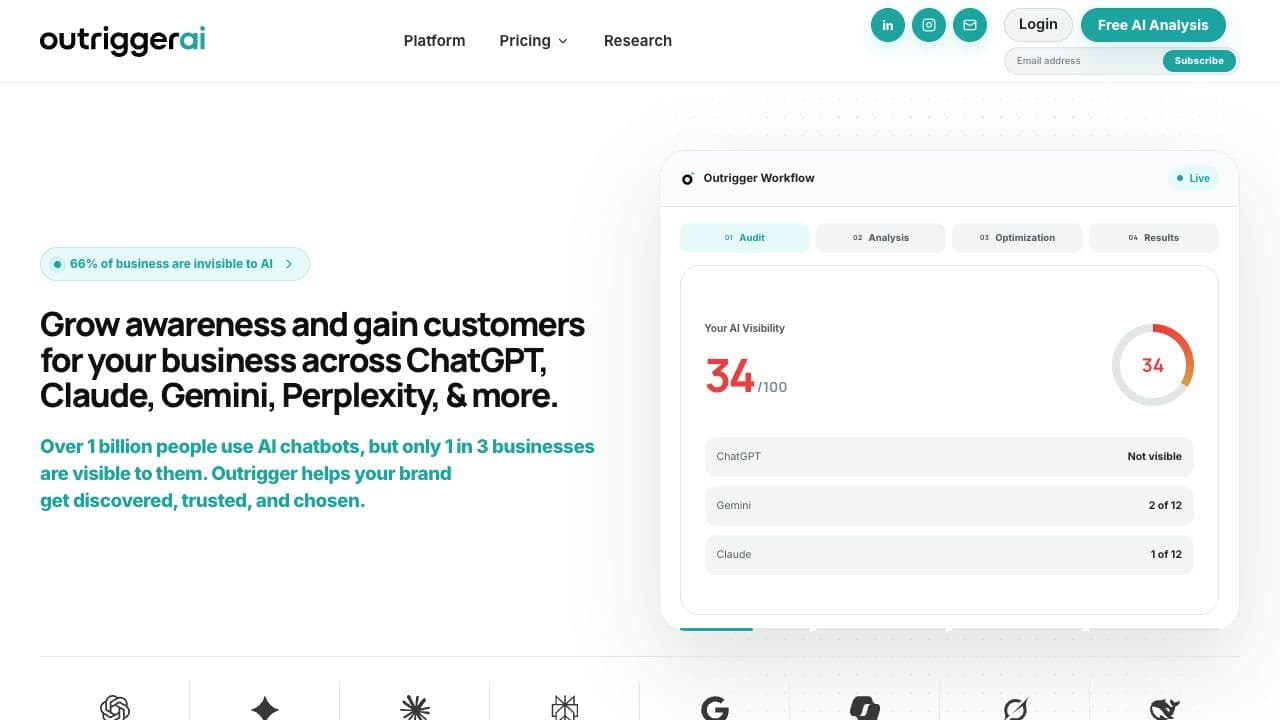
The Outrigger AI Visibility Index analysed 95,392 data points across 1,000 businesses and five AI models. In its April 2026 baseline, 65.9% of businesses were invisible across all five models.
This is public research, not an Xpand client result and not evidence that Xpand moved a client's AI visibility. Outrigger is a separate joint venture involving Joel House and Andrew.
The study shows why a baseline deserves attention. It does not predict what any model will say about your brand or what will change after evidence work.
Begin with what appears now
Start by sharing one specific problem, the outcome that matters and the evidence you already have. Before any work is scoped, Xpand will tell you what else would need to be inspected and whether the issue appears to fit.
The immediate goal is a clear decision about what should stay, what deserves attention and who should own the next step. This initial conversation does not promise a report, a result or that Xpand is the right owner.
The first move may be a clearer owned explanation, corrected entity information, stronger corroboration, a technical repair or no change until a more important foundation is fixed.
The evidence matters more than the tactic label.
Remeasure without claiming control
Record the question, system, date and source pattern. Make the agreed evidence change. Repeat the sample under documented conditions and compare directional movement, persistent gaps and new inaccuracies.
Answers can vary by question, model, source availability and date. No ethical operator can promise a mention, citation, position or recommendation from an independent AI provider.
What can be promised is a visible method, a controllable evidence action and a defined recheck. If a promised recommendation is required, this is not the right service.
GEO overlaps with SEO
Both may depend on clear entities, useful content, technical accessibility and credible authority.
The measurement question is different.
Search work commonly examines rankings, visibility, traffic and conversions. GEO adds direct observation of AI answers, brand context and cited sources across a dated question set.
Calling them identical misses the new evidence. Calling them unrelated ignores the foundations they share.
This works only when there is evidence to surface
The review is most useful when buyers use AI for discovery or comparison, the business has real expertise and customers, important claims can be substantiated and leadership will improve public evidence.
It is a poor fit for a brand seeking a markup trick, mass-produced content, a permanent rank or manufactured credibility for an unproven offer.
Here’s What Happens Next
Share the situation, the commercial outcome that matters and the evidence already available. If there is a useful fit, Xpand will explain what should be inspected before any work is proposed.
The immediate goal is a clear decision about what should stay, what deserves attention and who should own the next step. This initial conversation does not promise a report, a result or that Xpand is the right owner.
You decide whether to handle the next step internally, use another specialist, ask Xpand to scope it or leave it alone.
Replace anecdotes with a baseline
Waiting for perfect attribution will not reveal whether the brand is absent, distorted or weakly supported today. A dated baseline gives later work something honest to compare against.